
Authorized dealer · Certified installers · Charlotte, NC headquarters
360 Technology Group is an authorized Schlage dealer and certified installer
We have been selling, installing, programming and servicing Schlage systems across North and South Carolina since 2018 — more than 8 years. Our scope covers Schlage AD Series, NDE, LE and XE360 wireless locks, CTE and MTB readers and ENGAGE administration.
- Authorized Schlage dealer — we quote and supply genuine Schlage equipment, licensing and subscriptions.
- Certified Schlage installers — our technicians install, wire, program, commission and document the system.
- Repair and takeover — we service, troubleshoot, expand and take over existing Schlage installations we did not originally install.
- 24/7 emergency service — on-call service technicians for emergency repairs, plus scheduled preventive maintenance.
We cover every city in North Carolina and South Carolina from our Charlotte headquarters. Request a quote or service call Call 704-726-4254
Schlage enterprise hardware guide
AD Series, CTE and reader-controller architectures
Use AD Series when modular lock hardware and mature PACS integration fit the project; use CTE or RC where conventional electrified hardware and a separate reader make more sense.
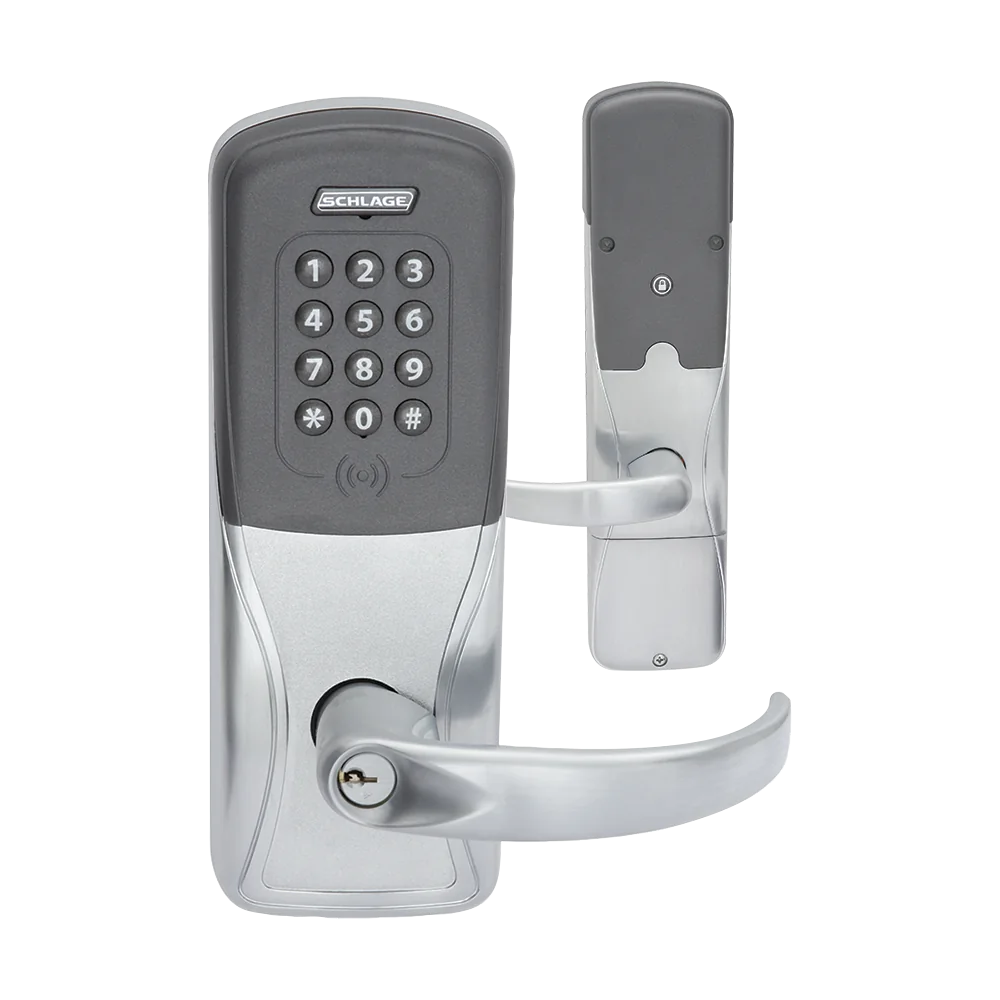
AD Series remains an active modular platform
The current Schlage electronic-lock catalog still lists AD-200, AD-300 and AD-400 products together with government-specific variants. AD Series integrates the lock, credential reader, request-to-exit, door-position and tamper sensing into one modular assembly. Reader modules and chassis options allow a project to standardize across offline, wired and wireless openings while preserving common aesthetics and service practices.
Do not label the entire AD family “legacy” simply because XE360 is newer. Instead, identify the required architecture and exact model. AD-200 is offline and economical; AD-300 is wired for supported real-time PACS operation; AD-400 uses encrypted 900 MHz radio through PIM400 infrastructure for real-time control. Government projects may require AD-302 or AD-402 as part of a tested FIPS/PIV solution.
AD-200 offline
Computer-programmable modular lock for openings that do not require continuous network communication. Plan visit/update frequency, audit collection and future conversion.
AD-300 wired
RS-485 networked lock for supported PACS integrations. Coordinate door cable, power transfer, voltage, topology, termination and controller compatibility.
AD-400 wireless
Encrypted 900 MHz networked lock with real-time PACS integration through PIM400 options; supports rapid centralized lockdown in a designed system.
AD-302 / AD-402
Government-focused products for FIPS 201-2 or related approved architectures. Approval applies to the tested complete solution, not the lock in isolation.
Application kits
Gate, elevator, portable-reader and wireless-reader-interface products extend specific AD architectures. Verify current status and integration before specifying.
CO Series
CO-100/200/220/250 provide standalone or offline alternatives for defined needs; compare capacity, programming method, lockdown and lifecycle separately.
AD Series architecture comparison
| Product | Connection and behavior | Important field requirements |
|---|---|---|
| AD-200 | Offline lock managed through supported software and local update workflow. | Exact reader, credential capacity, audit collection, visit frequency, USB/SUS tools, programming computer and future upgrade plan. |
| AD-300 | Wired RS-485 real-time lock integrated to supported PACS. | Power transfer, listed power, conductor and distance, topology/termination, controller interface, surge protection and door serviceability. |
| AD-400 | Encrypted 900 MHz wireless real-time lock communicating to a PIM400. | PIM type and PACS, radio survey, up to 200 ft obstructed or 1,000 ft clear-line manufacturer references, channel plan, batteries and lockdown test. |
| PIM400-485 | RS-485 panel interface for supported PACS architectures. | Device count, addressing, cable, controller integration, enclosure/power, firmware and supervision. |
| PIM400-1501 | IP/selected controller interface variant for supported systems. | Exact part suffix, Ethernet and controller requirements, certificates/security, licensing and PACS version. |
| PIM400-TD2 | Wiegand or clock-and-data interface for supported integrations. | Door count, bit format, event/status limitations, panel inputs/outputs and migration from unsupervised interfaces. |
AD-400 radio and real-time behavior
Schlage publishes 902–928 MHz spread-spectrum operation with AES-128 protected communications for AD-400. Manufacturer range references reach 200 feet through normal building construction and 1,000 feet clear line of sight. Those are planning ceilings, not guaranteed installed distances.
Survey the actual building for metal, masonry, elevator shafts, equipment, RF sources and door position. Record the chosen PIM location, each lock result and margin. Test remote lock/unlock, lockdown, door status, tamper, battery alarms, offline decisions and recovery through the actual PACS.
CTE controls conventional electrified openings
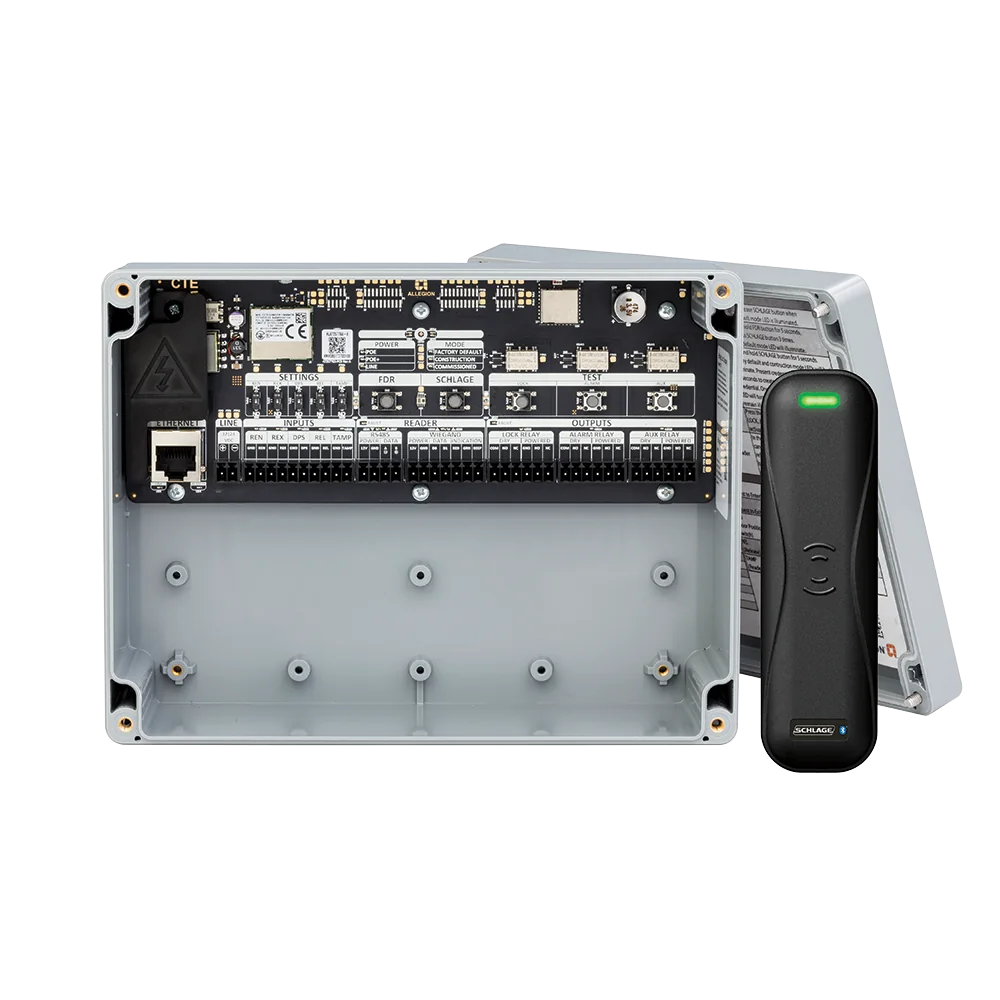
CTE is an ENGAGE-enabled single-opening controller sold with an MTB11 mullion or MTB15 single-gang reader. It interfaces with an electric strike, electrified lock, magnetic lock, exit device or automatic operator while allowing the opening to be managed alongside supported NDE, LE and Control devices.
Current public information identifies as many as 5,000 credentials and a 2,000-event audit at the CTE. Inputs include door position, request to exit, request to enter and remote release. The controller can receive updates over Bluetooth through ENGAGE or periodically through supported Wi-Fi operation.
CTE-MTB11
Single-door controller kit with a mullion-format mobile-enabled multi-technology reader.
CTE-MTB15
Single-door controller kit with a single-gang reader for wider mounting surfaces and standard boxes.
Reader credentials
BLE, NFC, 13.56 MHz smart and 125 kHz proximity are listed; No-Tour requires a supported smart credential with sufficient memory.
Controller power
Manufacturer installation material calls for 12 or 24 VDC and describes an indoor controller. Calculate controller, reader and lock loads separately.
Lock interface
Specify relay logic, fail-safe/fail-secure hardware, suppression, DPS, REX/REN, fire release, automatic operator and accessible timing.
Firmware
CTE and MTB have separate release notes. Record both versions and verify ENGAGE/PACS compatibility before updating.
CTE opening diagram
RC reader controllers and gateways
Schlage positions RC11 mullion and RC15 wall-mount IP reader controllers for scalable real-time access control with Pure Access Cloud or supported PACS systems. They combine reader and controller functions at the opening and can reduce conventional panel wiring, but they make the edge device, network switch, PoE budget, VLAN and cybersecurity part of the door design.
ENGAGE Gateway (GWE) connects supported ENGAGE-family wireless devices to real-time software integrations. Locate it by a documented radio survey, keep network and power available, and monitor both the gateway and every assigned lock. Do not assume a gateway count or range without the current integration guide.
RC11
Mullion IP reader controller for narrow mounting locations; verify selected credential option, PoE/network, lock interface and PACS support.
RC15
Wall-mount/single-gang IP reader controller for broader surfaces and supported real-time integrations.
GWE gateway
Short-range real-time bridge for supported ENGAGE devices. Survey placement and document assigned locks, network, power and firmware.
CT5000
Offline single-opening controller managed with Schlage Express and compatible offline device workflows; compare only when local updates are acceptable.
Credential readers require option-level verification
Schlage reader choices span mobile Bluetooth, NFC, 13.56 MHz smart credentials, 125 kHz proximity and keypad. AD, NDE and LE configurations with the Si or SiK option add secure-area support for selected HID iCLASS, iCLASS SE, Seos and NFC credentials. The same family name with a different reader option may not read the same credential securely.
| Credential question | Evidence required |
|---|---|
| What is presented? | Card/fob/mobile platform, frequency, technology, secure application, format and issuer. |
| What does the reader actually support? | Exact reader option and firmware, not only “multi-technology” marketing language. |
| Who owns encryption keys? | Named owner, key ceremony or authorization, encoder/configuration tools, backup and vendor dependence. |
| How is it issued and revoked? | Identity proofing, approval, expiration, lost card/phone, replacement, visitor and contractor procedures. |
| What legacy method remains? | Every proximity or Wiegand dependency, business reason, exposure and retirement milestone. |
| How is mobile supported? | Service agreement, compatible devices/apps/wallets, enrollment, privacy, offline behavior and alternate access. |
PACS integration and acceptance
Schlage publishes a PACS Alliance program with many supported integrations. “Open architecture” does not mean every feature works identically in every platform. Obtain the solution sheet and integration guide for the exact lock, reader/controller, interface and software version.
Commands
Verify lock, unlock, momentary access, passage, lockdown, privacy and schedule behavior with documented timing.
Status and alarms
Prove DPS, REX, forced/held, tamper, low battery, communication and power events and the operator response.
Cardholder lifecycle
Test add, change, revoke, expire, mobile replacement and downstream synchronization.
Audit
Confirm device and head-end timestamps, event detail, retention, search, export and recovery after an outage.
Version ownership
Name who approves and applies lock, gateway/PIM, controller, PACS, database, OS and mobile-app updates.
Support path
Record entitlement, product registration, system integrator, PACS vendor and official manufacturer escalation routes.
Continue to XE360 and ENGAGE wireless locks
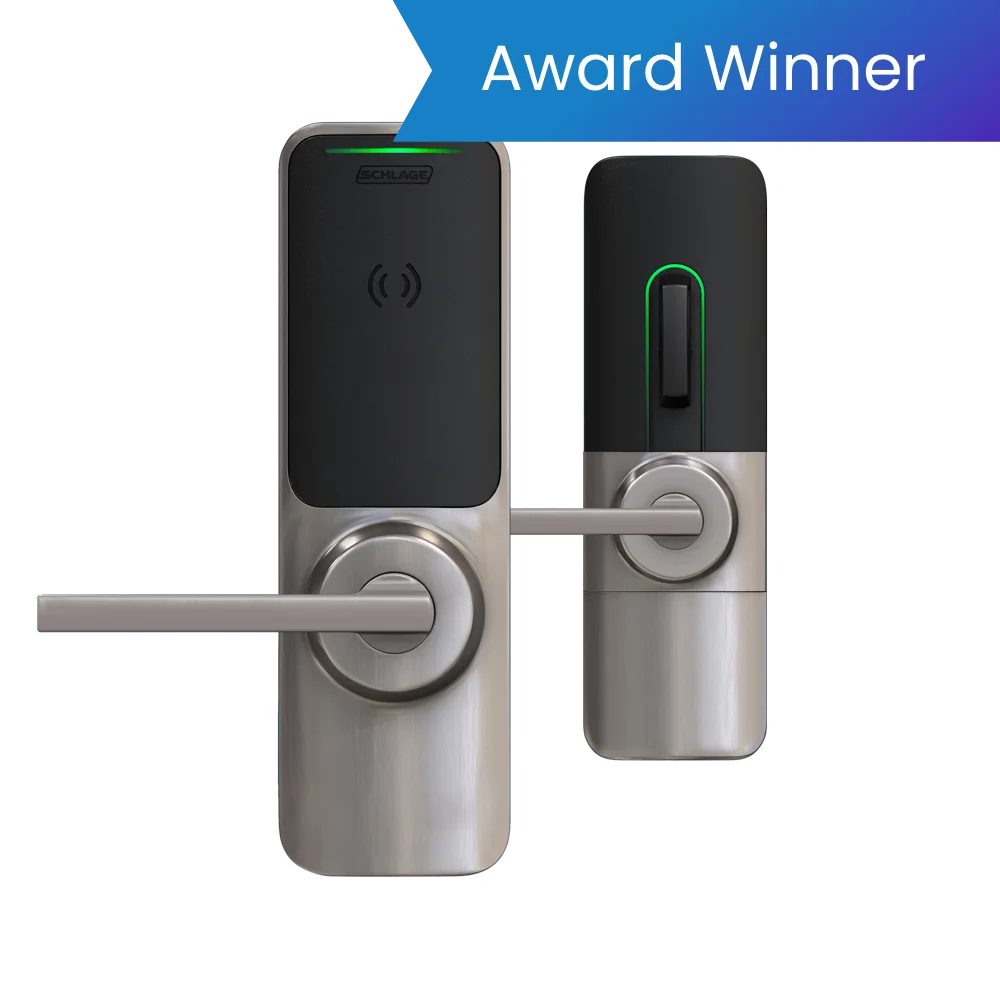
XE360, NDE, LE and Control
Review the current wireless family, ENGAGE capacities, RealSync and periodic Wi-Fi, No-Tour, mobile credentials and firmware workflow.
Schlage AD and reader-controller systems survey, commissioning and handoff
- Survey the opening: record door, frame, handing, lock and exit-device function, fire label, free egress, accessibility, cylinder, contact, request-to-exit and available pathways.
- Inventory technology: capture the exact model, hardware generation, reader option, credential technologies, firmware, hub or gateway, controller, software release, integration and license.
- Engineer infrastructure: document network segment, addressing, PoE or listed power, standby runtime, voltage drop, radio coverage, time service, certificates and monitoring.
- Commission every workflow: test valid, denied, expired and disabled credentials; schedules; privacy; passage; lockdown; remote commands; alarms; mobile access and mechanical override.
- Exercise failures: disconnect the server, network, gateway or hub, lock power and utility power, then verify local decisions, free egress, event buffering, alarms and recovery.
- Deliver lifecycle records: provide drawings, door schedule, configuration backup, version matrix, test results, training, spares, account ownership and links to official support.
Official product, support and download resources
Use official Schlage pages and the exact PACS integration documentation for specifications, installation, firmware and compatibility. 360 Technology Group does not host firmware or software installers.
Engineer the controller, reader and lock as one opening
We can compare AD, CTE, RC and ENGAGE architectures and document every power, network, credential, life-safety and integration dependency.
Official Schlage software, firmware and support
Use these manufacturer-owned portals for current downloads, release notes, manuals, advisories and technical resources. 360 Technology Group links to official sources and does not copy or host firmware files.
Update carefully: confirm the exact model, region, hardware revision, installed version, prerequisites, required intermediate releases, support entitlement, integrations, backup, maintenance window, rollback limitations and post-update tests. The wrong package or sequence can interrupt service or prevent a downgrade.
Some portals require a customer, dealer, certified-technician or active-support login. Cloud-managed products may update automatically and may not offer a public firmware file.